
When growth makes your organisation harder to see
As organisations grow, customer work moves across more people, teams, systems, decisions and hand-offs.
Leadership can know that improvement is needed while finding it increasingly difficult to see where work is flowing, where it is waiting, what is creating friction, and where to focus first.
Flow Intelligence helps organisations develop shared operational visibility — understanding how customer value actually moves, sensing the conditions affecting it, and delivering measurable improvement through repeated cycles of learning and adaptation.
Your Organisation Has Changed
Growth brings opportunity. It also brings operational complexity.
Customer work that once moved visibly between a small number of people may now cross sales, operations, delivery, finance, customer service, partners and multiple supporting systems.
Information exists throughout the organisation, yet the complete movement of customer value can become increasingly difficult to see.
Leadership may experience:
work waiting without a clear reason
increasing coordination and hand-offs
customer status spread across multiple systems
recurring operational issues
uncertainty about capacity and constraints
decisions based on incomplete operational information
improvement priorities competing for attention
The first opportunity is greater shared visibility.
The Difference Is Visibility

Pathway From Operational Complexity to Shared Visibility
Organisations do not need to begin with a large transformation program.
Flow Intelligence works progressively with owners, executives, Leadership Teams and the people closest to customer work to develop shared understanding, establish direction and deliver meaningful operational improvement.
Each stage builds on the previous one, creating a repeatable rhythm of learning, delivery and operational sensing.
01 - Recognising the Need for Greater Operational Visibility
Growth has changed how the organisation operates. Leadership recognises the need for improvement and greater visibility, while the right starting point may remain unclear.
02 - Operational Sensing Learning Circle
Develop a shared language for seeing the organisation as a connected system where customer value moves through people, decisions, information and technology.
03 - Initial Value Flow Mapping
Leadership maps its current understanding of how customer value moves, identifying the major stages, hand-offs, areas of concern and questions for deeper discovery.
04 - Initial Operational Model Discovery
Work with the people involved in the flow to understand how customer work actually moves, including its pathways, decisions, hand-offs, supporting systems and available evidence.
05 - Initial Implementable Operating Model
Bring the learning together into an initial shared operating model describing customer value flow, operational pathways, roles, supporting systems and observable signals.
06 - Partnership and Ways of Working
Establish responsibilities, decision-making, communication, governance and a practical delivery rhythm for evolving the operating model through use.
07 - 12-Week Operational Sensing Cycle
Apply the agreed ways of working to a focused organisational priority through small increments of work, evidence, feedback and operational signals.
The cycle is accelerated by the Flow Intelligence Operational Sensing SaaS, which progressively connects the operating model, operational signals, data and Mission Control into a shared operational view.
As the sensing layer develops, more of the organisation’s customer value flow becomes visible in use, helping leadership and operational teams see movement, waiting, constraints and emerging conditions earlier.
Each cycle delivers practical business value while strengthening the organisation’s capability to see, understand and improve how customer value moves.
08 - Ongoing Operational Sensing
Make operational sensing part of the organisation's normal way of working, progressively strengthening operational visibility, organisational capability and the operating model through repeated cycles of use, learning and refinement.
Enter the Pathway Where It Makes Sense
Every organisation begins from a different level of operational maturity.
The pathway provides a progression for developing shared operational visibility, while allowing an organisation to enter at the point that reflects its existing capability, current priorities and the support it needs to move forward.
Where useful foundations already exist, they can be validated and built upon. Where greater shared understanding is needed, earlier stages provide the foundation for what follows.
The starting point is established together, based on the organisation’s operational reality.
Greater visibility becomes an organisational capability
The pathway develops the organisation's ability to see, understand and improve how customer value moves as priorities and operational conditions evolve.
Explore the Pathway
If growth, complexity or change has made your organisation harder to see, this short explainer provides a practical introduction to the Flow Intelligence pathway.
It explores why operational visibility can become more difficult as organisations grow, how customer value moves across people, teams, systems, decisions and hand-offs, and how the pathway progressively develops shared understanding and operational sensing capability.
Use the explainer to consider where your organisation is today, what visibility already exists, and where additional support may help you move forward.
Get the Free Explainer
Your details are used to provide the explainer and support any conversation you choose to continue with Flow Intelligence. You will not be added to an endless sales email sequence.
How Operational Sensing Works
The pathway develops a shared understanding of how customer value moves through the organisation, the operating model that supports it, and the questions and hypotheses that should guide improvement.
The Flow Intelligence Operational Sensing SaaS progressively turns that understanding into an observable operational capability.
It works across four connected layers.
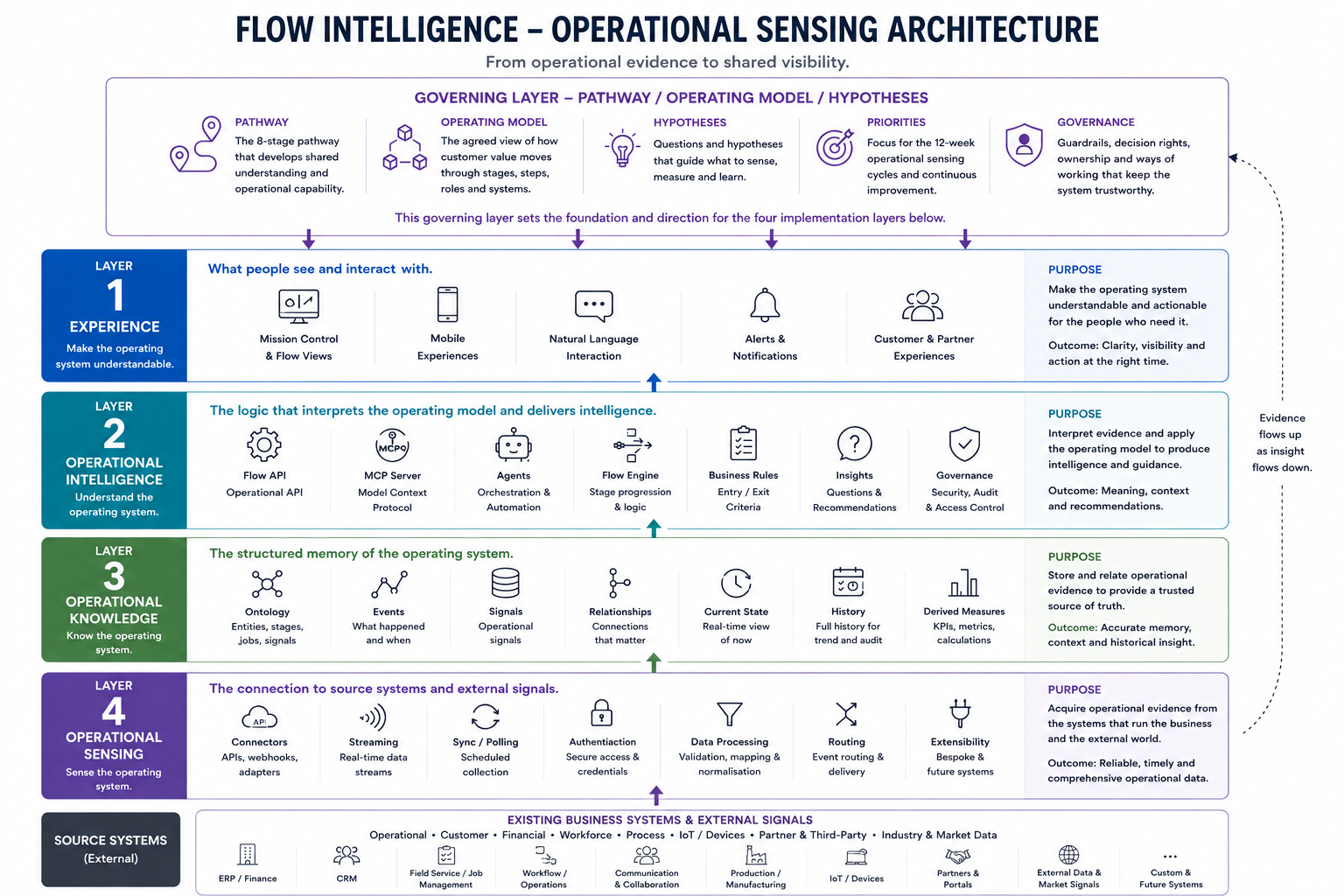
Layer 1 - Experience
Make the operating system understandable.
This is where people see and interact with the organisation's operational reality.
Flow views, Mission Control, alerts, mobile experiences and natural language interaction make customer value movement, operational conditions and emerging priorities increasingly visible to the people who need them.
Layer 2 - Operational Intelligence
Understand the operating system.
Operational Intelligence interprets the operating model and the evidence being produced across the organisation.
Rules, stage progression, questions, recommendations and governance controls help determine what operational evidence means and where attention may be required.
Layer 3 - Operational Knowledge
Know the operating system.
Operational Knowledge provides structured memory of how customer value moves through the organisation.
Events, signals, relationships, current state, history and derived measures provide the evidence needed to understand what happened, what is happening now and how operational conditions are changing over time.
Layer 4 - Operational Sensing
Sense the operating system.
Operational Sensing connects to the systems already supporting the organisation's work.
APIs, webhooks, adapters and other integration mechanisms progressively acquire evidence from operational, customer, financial, delivery and other relevant source systems.
Those systems continue performing the work they were selected to support. Flow Intelligence senses the evidence they produce and relates it to the organisation's operating model.
From operational evidence to shared visibility
The capability develops incrementally as the organisation moves through the pathway.
The initial operating model establishes what needs to be understood. Evidence and hypotheses guide what should be sensed. Each operational sensing cycle progressively strengthens the connections between source-system evidence, operational knowledge, intelligence and the experiences used by leadership and operational teams.
The result is an increasingly observable organisation - able to see how customer value is moving, understand emerging operational conditions and direct improvement through evidence.
Organisational Reality
Organisational Reality is a series exploring the systems, conditions and organisational realities that shape an organisation's ability to deliver, operate and adapt in a digital world.
The series follows the Flow Intelligence pathway, progressively examining what happens when organisational flow declines, visibility becomes incomplete, and hidden friction begins consuming capacity.
Organisational Reality #1: The Harder We Push, the Less We Move
What happens when organisational flow declines and force becomes the compensating mechanism?
Organisational Reality #2: When Visibility Becomes Narrative
What happens when leadership can see reports and status updates, while the conditions shaping delivery remain difficult to observe?
Organisational Reality #3: The Tax Nobody Budgeted For
What happens when organisational friction consumes capacity through waiting, rework, coordination and lost context, while the cost remains largely invisible?
Organisational Reality is a 10-part series released progressively, with each article exploring another aspect of organisational flow, visibility, friction and adaptability.
What We Believe
Organisations are made up of capable people working within connected systems of customers, work, decisions, information and technology.
As complexity increases, important operational conditions can become difficult to see. Flow Intelligence works with leadership and the people closest to the work to develop a shared understanding of how customer value actually moves through the organisation.
These principles guide how operational reality is explored, evidence is interpreted and improvement is progressed.
Our Principles
Reality Before Narrative - Seek to understand what is happening across the organisation and how customer value is actually moving.
Evidence Before Assumption - Use observable signals, operational evidence and lived experience to strengthen understanding and decision-making.
Understand Before Judgement - Explore the systems, conditions, constraints and interactions shaping an outcome before drawing conclusions.
Respect The People - The people closest to the work hold essential knowledge about how the organisation actually operates. Their experience is part of the evidence.
Make The Invisible Visible - Make flow, waiting, friction, constraints, uncertainty and other operational conditions visible enough to understand and improve.
Why Flow Intelligence
Flow Intelligence brings together operational sensing, systems thinking, technology leadership and practical delivery experience to help organisations develop a clearer understanding of how they operate.
The approach connects leadership perspective with the experience of people closest to customer work, then progressively relates that understanding to operational evidence from the systems already supporting the organisation.
This creates a practical connection between:
customer value flow
organisational and operational understanding
technology and source systems
data and operational evidence
leadership decision-making
measurable improvement
Flow Intelligence draws on experience across enterprise technology, AI and machine learning, platform engineering, delivery recovery, operational modelling and executive advisory.
The focus remains on the organisation itself - developing the visibility and sensing capability needed to understand what is happening, decide where to focus and improve how customer value moves.
Start a Conversation
If growth, complexity or change has made your organisation harder to see, a conversation can be a useful place to begin.
You may already know that improvement is needed while still finding it difficult to see where customer work is waiting, what is creating friction, which constraints matter most, or where attention should go first.
Flow Intelligence works with owners, founders, executives and Leadership Teams to develop greater shared visibility of how customer value moves through the organisation and identify a practical starting point for improvement.
A conversation may be useful if you are seeking greater clarity around:
customer value flow
operational visibility
work in progress and waiting
capacity and constraints
coordination and hand-offs
operational signals and evidence
leadership focus and decision-making
where to begin improving the operating model
The starting point is shaped by your organisation's current maturity, operational reality and the support needed to move forward.
LinkedIn → Steven Van Bodegraven